Vendor-specific hub APIs
Keep applications off proprietary hub contracts by putting an omlox-aligned API and policy layer in front of them.
Integration product
Open Location Hub is a cloud-capable hub of hubs for filtering and aggregating location data from on-premise omlox hubs. It gives business-facing applications one interoperable API layer for live locations, events, auth, and federation.
Location deployments often end up with vendor-specific hub logic, custom APIs, and one-off middleware between devices, business systems, and applications. Open Location Hub gives teams one integration point they can deploy locally, in the cloud, or as a federated aggregation layer.
Keep applications off proprietary hub contracts by putting an omlox-aligned API and policy layer in front of them.
Reuse auth, routing, connector, and event-exchange infrastructure instead of rebuilding it for each customer or site.
Connect existing on-premise hubs and multiple tracking technologies without forcing every site onto one stack.
Open Location Hub connects live location feeds, applies auth and policy, filters and aggregates hub data, and gives downstream applications one place to integrate.
Use one hub boundary for location-aware products, enterprise software, and operational workflows instead of wiring each system directly to local vendor infrastructure.
Keep auth, permissions, RPC control, and event routing in one deployable component.
Move from on-premise installations to regional and global aggregation without replacing the integration model.
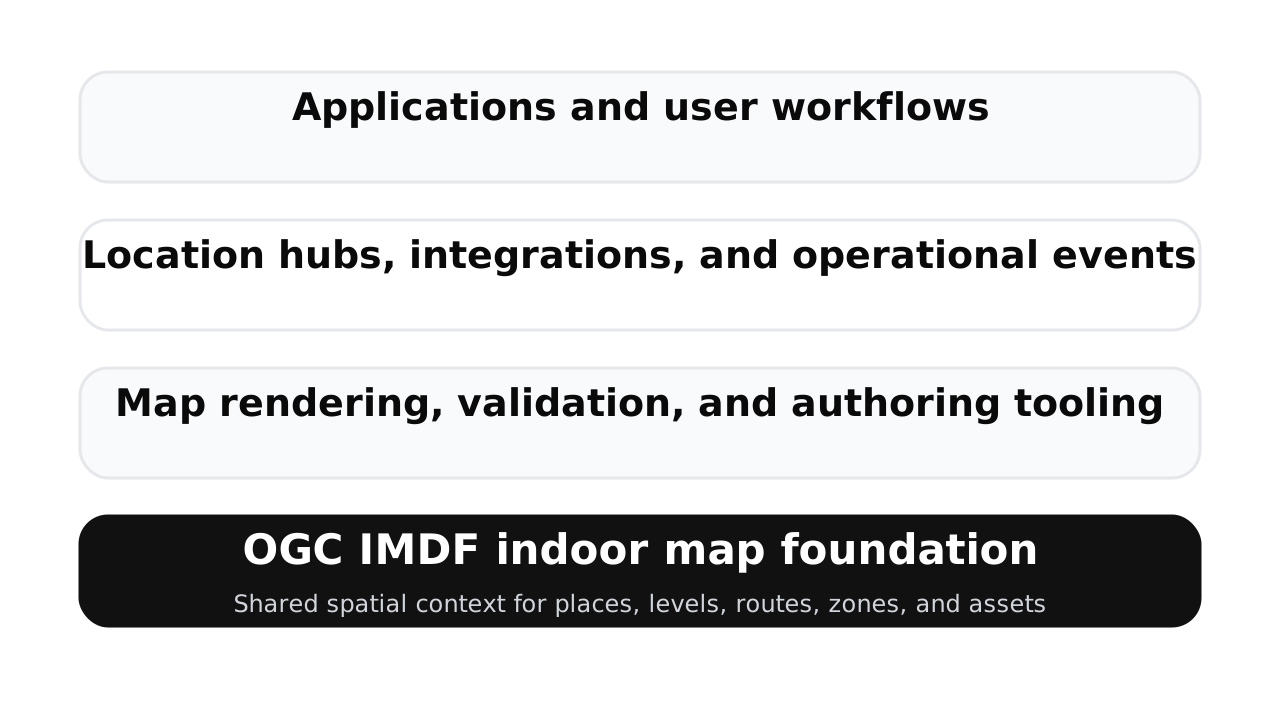
Open Location Hub is not a rip-and-replace story. In real plants, terminals, warehouses, and production sites, teams usually need to connect on-premise hubs that already exist and add a cleaner interoperability layer around them.
Connect on-premise omlox hubs such as Corriva Hub, Deephub, and similar implementations that already handle local device or site-level location traffic.
Bring together RTLS, GNSS, barcode, QR, and related tracking flows so downstream systems do not depend on one narrow vendor contract.
Filter, normalize, and route location data across vendors while preserving existing site investments and operational constraints.
Contributed connectors make compatibility visible and cut one-off integration work for solution providers.
`olh` is the Open Location Hub CLI. It is designed to work with any omlox 2.0-compatible hub implementation, so teams can script setup, validate APIs, inspect streams, and run operational checks without building custom tooling first.
Install `olh` from `jillesvangurp/tap/open-location-hub-cli` and use Bash or Zsh completions for repeatable local workflows.
Create, list, update, summarize, and delete zones, trackables, providers, and fences from the command line.
Post locations and proximities, inspect transient state, and stream location, motion, fence, and collision events as NDJSON.
Resolve credentials from flags, environment variables, or `~/.openlocationhub.env`, and fetch OAuth tokens automatically when settings are present.
Discover and invoke JSON-RPC methods such as hub diagnostics and command-routing calls.
Use JSON output and scripted commands to test omlox-compatible hub behavior across local, on-premise, and cloud environments.
Many workplaces already organize locations as hierarchies such as site, hall, aisle, area, line, or station. Outdoor operations do the same with countries, regions, cities, campuses, yards, and administrative zones. IMDF can capture those relationships in the map itself, so existing location structures become geocodable addresses.
A position can be understood as Plant 3, Hall B, Aisle 12, Zone 4 instead of just a coordinate. That matches how operators, supervisors, and ERP or MMS users already talk about the site.
Many enterprise systems already store workspace hierarchies for assets, work centers, storage areas, and production zones. Putting the same hierarchy into the map creates a direct bridge between business data and location-aware applications.
The same pattern works outside. Administrative hierarchies such as country, city, district, campus, yard, and gate help people find places and understand where events happened.
When IMDF stores these parent-child relationships, applications can geocode them. That means people can search, route, and report against familiar addresses instead of raw coordinates or custom lookup tables.
The current repository already covers the hub contract, core runtime, protocol surfaces, and operational building blocks needed for serious implementation work.
An OpenAPI contract for resource management, ingest, and standard hub behavior.
A Go server with strict handler interfaces and a low operational footprint.
Local runtime support for Postgres, Valkey, Mosquitto, and the application itself.
JWT bearer auth with `oidc`, `static`, and `hybrid` verification modes.
RBAC, ownership-aware authorization, route-level permissions, and WebSocket topic permissions.
Shared paths across REST, WebSocket, and MQTT plus an OMLOX RPC control plane.
Real deployments rarely have one integration style. Open Location Hub is designed so CRUD APIs, streaming updates, local MQTT integration, and controlled command execution can live behind one hub boundary.
Use standard APIs for ingest, resource management, and hub-facing application integration.
Support subscriptions, event fan-out, and the OMLOX wrapper protocol for live flows.
Handle local device, adapter, and site-level telemetry patterns without pushing every consumer down to device-facing protocols.
Use the hub as the control-plane front door for diagnostics and command routing such as `com.omlox.ping`, `com.omlox.identify`, and `com.omlox.core.xcmd`.
Open Location Hub is designed for deployment topologies where on-premise omlox hubs feed regional cloud hubs, and regional hubs feed a business-facing global aggregation layer.
Support countries, business units, and sites that use different location technologies, local integrators, and on-premise or cloud infrastructure.
Filter and aggregate across sites, tenants, regions, and jurisdictions while still respecting local operational constraints.
The same model can start at one local deployment and grow into a wider federated architecture over time.
Start with the docs and API reference, then inspect the repository if you need to validate the architecture, auth model, or connector direction.