Bitmap venue maps do not scale
Indoor products still rely on bitmap exports of CAD drawings far too often. Structured vector maps are easier to render, edit, validate, and reuse.
Open source building blocks for location software
Open Location Stack gives vendors, integrators, and product teams reusable software for hub federation, omlox-compatible integration, command-line operations, and indoor maps across mixed-vendor deployments.
Created by FORMATION
Supported by





Many location products still rebuild the same hub logic, SDK glue, and map tooling just to get positions on a screen. That wastes engineering time and leaves customers with brittle integrations.
Indoor products still rely on bitmap exports of CAD drawings far too often. Structured vector maps are easier to render, edit, validate, and reuse.
Location systems only become useful when they connect cleanly to business software and customer workflows. Rewriting adapters for every RTLS vendor is wasted effort.
When hub and integration layers stay proprietary, integrators and product teams inherit more cost, more coupling, and fewer options.
Location solutions depend on many hardware and software components across vendors and sites. Rebuilding the same hub, connector, and mapping layers in private silos adds cost and complexity. Open source gives teams something reusable to start from.
Use the stack in customer projects, packaged offerings, internal tools, or partner-delivered solutions without license friction.
Start from open hub, connector, and mapping components instead of rebuilding the same infrastructure for every deployment.
An open codebase is easier to inspect, adapt, extend, and integrate across mixed-vendor deployments.
The stack is split into focused projects that can be used together or adopted separately.
Use the hub for location aggregation and the CLI for repeatable setup, ingest, streaming, and diagnostics.
olh is a command-line client for omlox 2.0-compatible hub implementations. It covers login, resource CRUD, ingest helpers, WebSocket streams, JSON output, and RPC calls.Use structured venue data to make location updates usable in products, dashboards, and operational workflows.
Open Location Hub is a cloud-capable hub of hubs for filtering and aggregating location data from on-premise omlox hubs, then exposing that data to business-facing cloud applications.
Keep application teams off vendor-specific hub contracts while preserving local omlox-compatible deployments.
Bring together RTLS, barcode, QR, GPS, and related location systems across sites, zones, and assets.
Run local hubs on premise, aggregate selected flows in the cloud, and scale horizontally across sites, regions, and tenants.
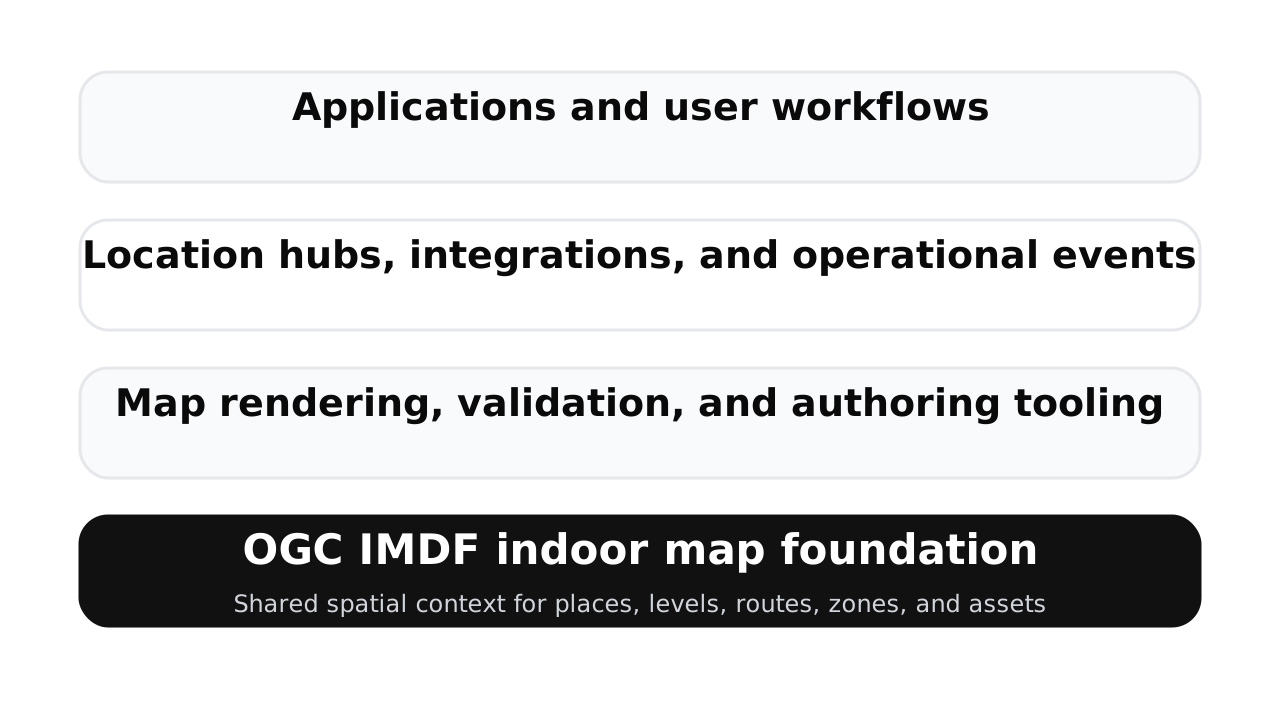
The mapping side of Open Location Stack focuses on structured indoor map data instead of static floor-plan images. That gives teams a better base for rendering, routing, zoning, and validation.
Places, levels, routes, and zones need a shared indoor model before live positions from multiple systems can be interpreted correctly.
A strong map layer helps teams work with mixed tracking systems, site hierarchies, and operational activity in the same model.
Structured map data makes authoring, validation, rendering, and maintenance more reusable across projects.
Open Location Hub supports a wide range of connectors, so existing deployments can participate without a rip-and-replace project.
Plug in on-premise or cloud hubs such as Corriva Hub, Deephub, or other existing deployments where location data is already flowing.
Bring together barcode and QR-based flows, GNSS, camera-based systems, RFID, BLE, UWB, and other location technologies.
Send and receive location data and operational events between the hub and ERP, MMS, SAP, and related enterprise systems using reusable connectors.
Location solution providers can contribute connectors, show compatibility, and list support on the Open Location Stack website.
Location data comes from many technologies, from software systems and optical workflows to passive tags, outdoor positioning, and precise indoor positioning.
ERP, MMS, WMS, MES, SAP, and existing location platforms and hubs.
1D and 2D codes, OCR, and AI-based object recognition.
RFID and NFC.
GNSS, telematics, and fleet tracking.
UWB, BLE, Wi-Fi RTT, and related indoor positioning systems.
Most systems only track assets for part of their lifecycle and in limited areas. Cradle-to-grave tracking needs location data from production and logistics through customer use to recycling or decommissioning.
AI systems in logistics and manufacturing need map context, live location flows, and system events in the same place. Open Location Hub is built to connect those inputs.
AI systems need a usable picture of facilities, fleets, flows, and constraints instead of disconnected location feeds.
Open Location Hub connects workplace systems, indoor maps, and mixed tracking technologies so automation can work from one shared model.
A shared hub, semantic map structure, and reusable connectors create a better base for orchestration, monitoring, and AI-assisted decisions.
Open Location Stack gives integrators, vendors, enterprise teams, and developers reusable software to start from instead of forcing each group to rebuild the same core pieces.

Deliver mixed-vendor location solutions faster by reusing shared hub, connector, and mapping components instead of rebuilding the same integration layer for every project.
Make your products easier to integrate into real customer environments with interoperable APIs, connectors, and better tooling.
Reduce deployment and integration risk with a base that fits more naturally into existing enterprise systems and data flows.
Start with practical middleware and connector frameworks so teams can focus on application logic and delivery.
Follow product and engineering updates as the repositories, docs, and releases evolve.
Open Location Hub was tested as a hub of hubs at the omlox Plugfest 2026 in Lemgo, aggregating live updates from multiple omlox-compatible systems into FORMATION.
A short update on the first companies on the Open Location Stack logo wall and how their tracking technologies fit the direction of Open Location Hub.
Open Location Hub now supports optional Kalman Filtering to derive speed and direction, emit locations at configurable rate. Also adds a Pacman UWB simulator to play with this.
Why bitmap floor plans are technical debt for asset tracking, and why georeferenced vector maps and IMDF are a better path.
Open Location Hub 0.1.0 is the first public release with full omlox API coverage for the current scope, plus MQTT, WebSocket, RPC, Docker images, and benchmark data.
A repeatable Open Location Hub benchmark built from a five-minute OpenSky Germany capture, replay interpolation, and OTLP telemetry.
Easter 2026 update on the LogiMAT soft launch, public repositories, hub maturity, replay tooling, and OTLP observability.
Mailing list
Subscribe to receive updates about new releases and news for the Open Location Stack.
Subscription
Open Location Stack stays standards-aligned across hubs, maps, and live operational systems so mixed deployments can interoperate more cleanly.
open locating standard
OMLOX defines interoperable RTLS interfaces, including hub APIs and core-zone compatibility across vendors and applications.
Open Geospatial Consortium Indoor Mapping Data Format
IMDF is the structured indoor mapping model Open Location Stack uses for portable venue maps and spatial context.
Message Queuing Telemetry Transport
MQTT is a lightweight transport for ingesting and distributing live telemetry, events, and updates around the map.
Contact us with RTLS integration blockers, indoor mapping use cases, connector ideas, or partnership interest that should influence the next Open Location Stack releases.